
.png)
.png)


A Buyer's Guide to Santa Barbara & Montecito's Architectural Styles
I get some version of the same question on almost every tour: "Is this a Spanish house?" Usually the answer is yes, but not always in the way people expect. Santa Barbara's look wasn't an accident — it was a deliberate rebuild after the 1925 earthquake flattened much of downtown, and the city doubled down on Spanish Colonial Revival on purpose. Montecito's story is a little different, shaped as much by ranch land and old money as by any single design mandate. Once you know that history, you start to see the neighborhoods differently — and it makes touring homes a lot more useful.
Here's how I break down the styles I show most often, what they're actually like to live in day to day, and what I tell every buyer to ask before they fall for a facade.

Spanish Colonial Revival
This is the style that put Santa Barbara on the map, largely thanks to architect George Washington Smith, who moved to Montecito in the 1910s and became the closest thing this style has to a founding father — his work at Casa del Herrero and the Lobero Theater still gets studied today. After the 1925 quake, the city leaned into his vision citywide: white stucco walls, red clay tile roofs, wrought iron, and arched openings became the rule rather than the exception, especially downtown in what's now the El Pueblo Viejo historic district.
You'll see the strongest, most consistent concentration of this style downtown and around the Riviera and Samarkand, but plenty of the estates I sell in Montecito draw from the same design language on a grander scale.
What it's like to live in one: The courtyards aren't decorative — they work. Thick stucco walls and interior patios keep these homes noticeably cooler in August than anything with more glass, and the whole layout tends to pull you outside. Loggias, garden patios, tiled fountains — the indoor-outdoor line barely exists.
What to ask about: If a home is within El Pueblo Viejo's boundaries, any exterior work — roofing, windows, paint colors — goes through design review with the Historic Landmarks Commission before you can touch it. That's not a dealbreaker, but it changes your renovation timeline, so I always flag it early. For anything built before the 1970s, I also want to know when the plumbing, electrical, and foundation were last touched.
Mediterranean & Hacienda Style

Close cousin to Spanish Colonial, but built for a different kind of land. Where Spanish Colonial favors compact, vertical massing, Hacienda-style homes sprawl — low rooflines, exposed wood beams, and a layout built around a central courtyard rather than a hallway. This is the style you'll find most often on the larger parcels in Montecito's foothills, where the ranching history of the area is still visible in the bones of the architecture.
What it's like to live in one: These homes are built horizontally. Wide primary suites, long covered walkways, and outdoor living space that often rivals the indoor square footage once the weather's good — which, here, is most of the year.
What to ask about: Larger Montecito parcels frequently come with well water, septic systems, or a private road maintenance agreement shared with neighbors. I walk every buyer through all three before we're deep into escrow, because they affect your monthly costs in ways the listing sheet won't spell out.

Contemporary & Modern
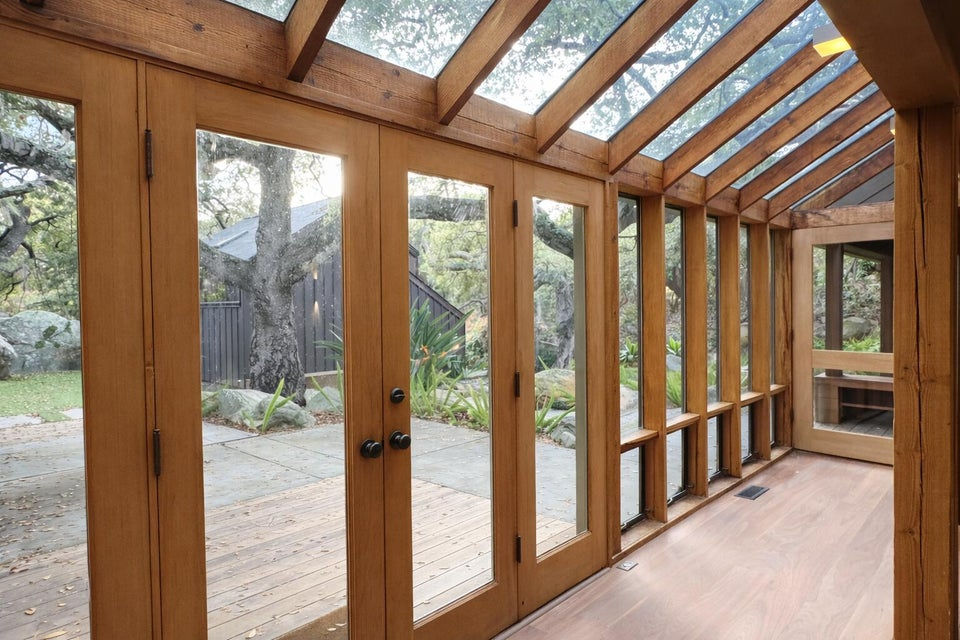
Not everyone wants an arch and a tile roof, and the market here has caught up — you'll see it most in newer builds and remodels on the Mesa, in Hope Ranch, and tucked into pockets of Montecito. Clean lines, walls of glass, flat or low-pitched rooflines, and a design language built to frame a view rather than reference the past.
What it's like to live in one: Open, bright, and view-forward — but you give up some of the passive cooling that older Spanish homes get for free from thick walls and shaded courtyards. On a hot September afternoon, that's worth thinking about.
What to ask about: Flat roofs and large glass expanses ask more of their materials than a pitched tile roof does. I always ask about roofing type, waterproofing history, and window and door seals — these are the maintenance items that quietly separate a well-built modern home from a costly one.
California Craftsman & Cottage
Tucked through downtown and the Upper East side, you'll still find early-1900s Craftsman bungalows — low, wood-sided, deep front porches, exposed rafter tails. They read warmer and more informal than their Spanish neighbors, and they tend to sit on some of the most walkable streets in the city.
What it's like to live in one: Smaller footprints, more character, closer to downtown. Buyers who choose these over a larger Spanish estate are usually optimizing for walkability and charm over square footage — and in this market, that's a completely reasonable trade.
What to ask about: As with any home built before 1950, I ask about foundation type, past additions, and seismic retrofitting. It's a short conversation that saves a lot of surprises later.
Questions I Ask On Every Tour, Regardless of Style
Has the home been seismically retrofitted, and when?
What's the roof material and its age? Tile holds up well but isn't immune to decades of settling and cracking.
Is the property inside El Pueblo Viejo or another design-review district — and what does that mean for future changes?
How does the home manage heat without relying on shade, courtyards, or cross-ventilation?

Finding the Right Fit for How You Actually Live
There's no "best" style here — a Spanish Colonial estate and a glass-walled contemporary home can sit two streets apart and both be exactly right, just for different people. The real question is how you want your days to feel: shaded courtyards and thick walls, or open glass and unobstructed views.
If you're weighing styles and neighborhoods and want a more specific read on what's available right now — including some opportunities that aren't publicly listed — I'm happy to walk you through it.
Looking to purchase in Santa Barbara or Montecito?
Reach out at Josh@JoshRamirez.com
or (805) 455-9066
I'd love to help you find the right home.


Comments